

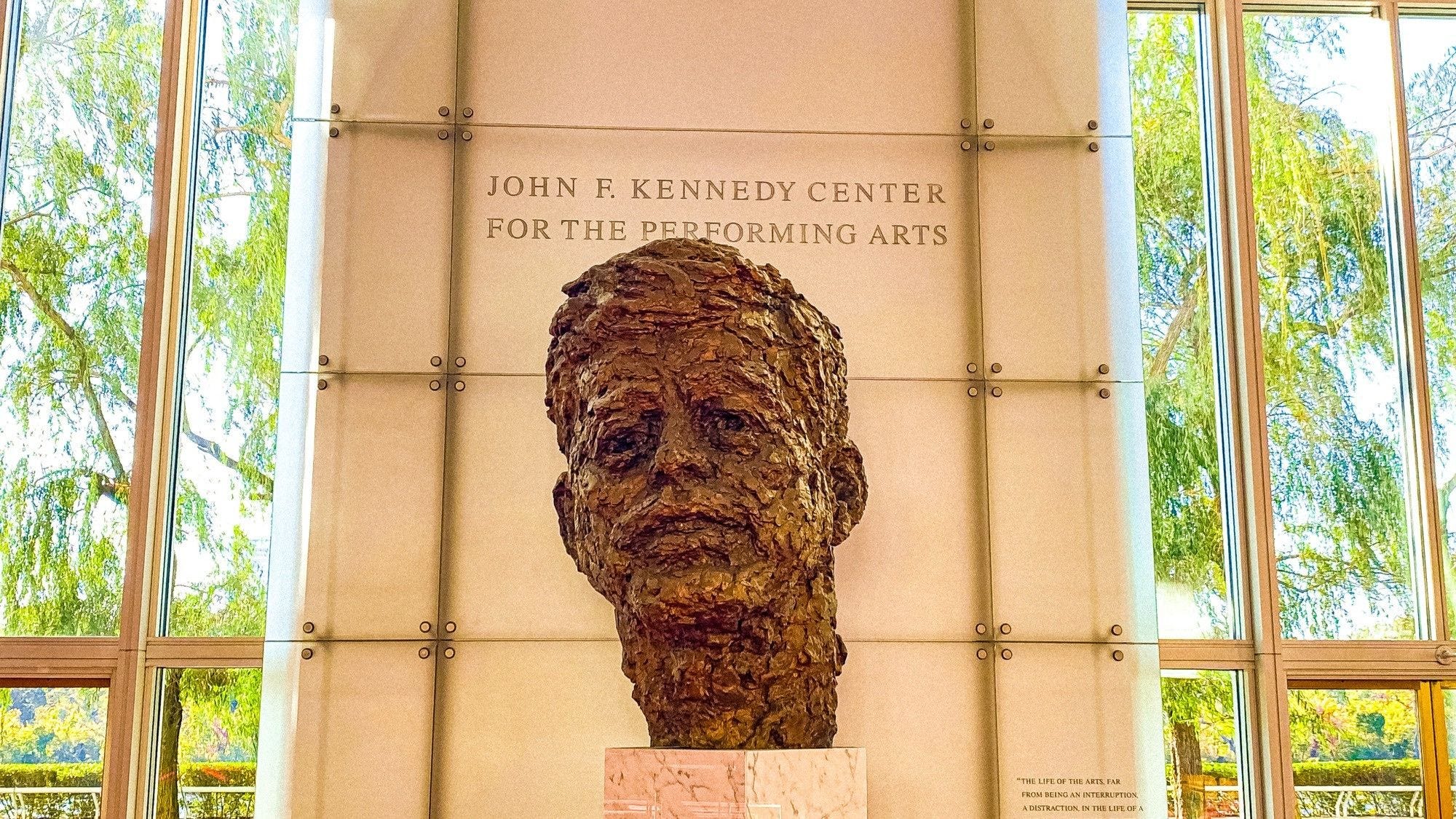
For those of us who grew up inside the world of the nonprofit arts, the Kennedy Center for the Performing Arts was never just another venue.
It was an idea.
I felt that long before I ever set foot in Washington. I felt it growing up in Los Angeles, experiencing theatre through the curatorial lens of Gordon Davidson at Center Theatre Group. Davidson didn’t just produce plays—he built ecosystems for artists. He treated theatre not as product but as civic life.
So, when I first learned that Leonard Bernstein tapped Davidson to stage Mass to inaugurate the Kennedy Center in 1971, it always struck me as perfectly fitting. One visionary artist inviting another to help open the nation’s performing arts center.
That’s what the place was meant to represent.
Which is why watching the past year unfold has felt less like a leadership transition and more like a cultural demolition.
Now Richard Grenell is stepping down after a disastrous tenure leading the Kennedy Center, following the political takeover engineered by Donald Trump and a loyalist board. The upheaval began when longtime president Deborah Rutter was abruptly pushed out, signaling that something fundamental had changed. The nation’s flagship arts institution was suddenly being treated less like a cultural trust and more like a political asset.
Or perhaps more accurately, like a branding opportunity.
Trump has spent a lifetime putting his name on buildings—towers, casinos, hotels. But cultural institutions aren’t real estate deals. You can slap a name on a skyscraper. You can’t manufacture cultural legitimacy.
The MAGA board that swept into the Kennedy Center seemed to believe the arts ecosystem would simply keep functioning. That artists would still perform, organizations would keep partnering, and audiences would keep showing up.
Instead, artists pulled out. Organizations canceled appearances. Ticket sales seemingly plunged. The Kennedy Center, already fragile after the pandemic’s devastating impact on the arts, suddenly found itself in a downward spiral of its own making.
Grenell eventually found himself presiding over a shrinking stage. When the artists leave and the audience stops showing up, even the most enthusiastic political appointee begins to look for the exit.
Blowing things up is easy. Running the institution afterward is the hard part.
There’s an irony here. For years, many of the country’s economic elites convinced themselves that supporting Trump was a manageable gamble. Money talks, after all, and perhaps they assumed that if they could get his ear, they could steer him away from the chaos.
But they appear to have badly misread the arts.
The cultural ecosystem runs on trust—between artists, institutions, donors, and audiences. Once that trust collapses, the ripple effects move fast. The places people once assumed would always be there—the orchestras, theatres, and national stages—suddenly look far more fragile.
There’s also a small detail worth mentioning.
The building on the Potomac is still officially called the John F. Kennedy Center for the Performing Arts, vanity signage or not.
Not the Trump Center. Not the MAGA Cultural Complex. Not whatever gilded rebrand some political consultant might dream up next.
Just the Kennedy Center.
It was named for John F. Kennedy, a president who believed the arts mattered to democracy. During his presidency, artists were welcomed into the White House not as decoration but as participants in civic life.
So, forgive many of us in the arts community if we decline to participate in any gaudy attempt to rename or rebrand it.
The initials on the building are JFK.
They will still be there long after the latest political vanity project has faded.
The Kennedy Center must return to its roots—celebrating the diverse arts of this country and elevating artists whose work might never survive in a purely commercial marketplace. Not all art is meant to turn a profit.
Some of it is meant to turn a culture.
Which is also why it’s worth pushing back when even the culture industry itself takes cheap shots at the arts. Recently, Timothée Chalamet sparked backlash after dismissively suggesting that ballet and opera are art forms “no one cares about anymore,” a snarky remark that drew swift responses from artists across those communities, not to mention becoming a trolling meme across social media.
Perhaps someone should invite him to spend an evening at the Kennedy Center once it remembers what it’s supposed to be.
Because the institution was never meant to chase popularity contests or quarterly metrics. It was meant to give a national stage to artists like Leonard Bernstein and Gordon Davidson—artists who believed the purpose of art wasn’t simply to entertain the moment.
It was to shape the culture that comes next and celebrate the arts that make America great.
And that is a mission far more enduring than any political takeover.