

I grew up only somewhat aware of what it meant to be Jewish. We celebrated what I think of as the Hallmark holidays—Hanukkah and Passover—but didn’t go to temple or talk much about religion. I’d tell friends I was “culturally” Jewish, not religious. That held for most of my childhood.
In the very white suburbs of Los Angeles County, I don’t remember having Jewish friends—though, given how little we talked about it, maybe I just didn’t know. I heard plenty of friends complain about being dragged to church. Never synagogue. I knew I was Jewish, but didn’t know what that actually meant. I also don’t recall encountering antisemitism. In a working Hollywood family, being Jewish didn’t register as different. No Hebrew school, no bar mitzvah. Did I consider myself Jewish? Yes. Did I present that way to the world? Eh—mostly Jew-ish.
Still, those holidays left a mark. I listened at the Seder table, absorbed the story of exodus, belted out “Let My People Go.” And when it came to my real obsession—Hollywood—I gravitated toward Jewish artists without fully understanding why. My dad introduced me to the Marx Brothers, the Three Stooges, Billy Crystal, Mel Brooks, Woody Allen—just as great entertainers, not as Jews. Looking back, there was clearly a pull. The same instinct that made me care a little too much about the Seder was at work in my love for those artists.
That curiosity turned into something like study. My version of Talmudic learning was devouring biographies of Jewish Hollywood figures—Lew Wasserman, Irving Thalberg, the original moguls. I wanted in. But my connection stopped at culture. Religion never entered the picture.
I could walk the Paramount backlot with my dad and imagine those early Hollywood years, but I couldn’t grasp the pressure those men felt as Jews trying to belong in America. I hadn’t experienced othering in any meaningful way. Beyond being a little nerdy and not especially masculine, I moved through the world without friction. The idea that Hollywood was, in part, a refuge from exclusion never quite landed.
That changed in the Air Force.
At Lackland Air Force Base, Sunday meant church—and a break from the drill instructor. Friday, technically, was for Jewish services. When our flight was asked if anyone wanted to attend, no one raised a hand. I didn’t either. I remember someone laughing when “Jewish” was mentioned. Not loudly, but enough to register.
I stayed quiet. Followed the group to Sunday services. It felt like self-preservation. Basic training wasn’t about standing out. It was about blending in, doing what you were told, becoming part of the unit. Still, that small moment stuck with me.
Later, at my first base assignment, I couldn’t avoid it. My roommate—loud, proudly Southern, devoted to college football—invited me to church. This time, I easily told him I’m Jewish.
He got animated. He told me he’d always heard Jews had horns.
At first, I assumed he was joking. He wasn’t. He kept going. I shut it down quickly, but something in me shut down too. I had grown up thinking antisemitism was history, not something you ran into in a dorm room. After that, I avoided him as much as possible. But the experience stayed with me. It forced a question I had never seriously asked: what does it actually mean to be Jewish in the world?
When I returned home, I went looking for answers. I found a reform temple, started talking with a rabbi, attended Torah study. It wasn’t God I was after. It was connection—to history, to something larger than myself. And as I dug in, the work of the artists I loved took on new meaning. The humor, the music, the storytelling—it all landed differently.
The tension remained. I was proud of the connection but hesitant to let it define me. That push and pull—between being culturally Jew-ish and wanting something deeper—didn’t resolve so much as begin to feel comfortable.
I later came across a passage that helped make sense of it. Writing in The New Yorker, Michael Schulman described how Hollywood’s early Jewish founders navigated their own identities:
“The Jewish studio heads were immigrants, or the children of immigrants, who had fled pogroms in Eastern Europe and faced pervasive antisemitism in America, where they longed to assimilate… Even as they lifted movies into the mainstream of American culture, they whitewashed the screen of minorities, including their own, in order to uphold a sanitized vision of the country.”
That word—sanitized—resonated.
Without realizing it, I had done the same. I downplayed my Jewishness when it felt inconvenient. Not out of fear for my safety, but to avoid discomfort. A softer, more modern version of the same instinct.
After the military, as I became more grounded in Jewish life, I briefly swung in the other direction. I wanted to marry Jewish, raise a Jewish family, draw a clear line. But over time, that didn’t feel right either. I loved the connection, but not the idea of closing off the rest of the world.
I thought about Lew Wasserman, who once declined to join Hillcrest Country Club—founded because Jews were excluded elsewhere—because it was restricted. He didn’t want in on something that excluded others, even in response to exclusion. That rang true for me. I valued being Jewish, but also the “ish.”
Today, I’m comfortable saying I’m a Jew. Fully. And outwardly, although not narrowly. I married a non-Jewish woman, and we’ve chosen to let our kids find their own way rather than impose one. At the same time, I know my connection to Jewish culture—especially through film and theater—will shape what I share with them.
I found a kind of mirror in Stephen Sondheim, who once described himself as a “West Side Jew,” raised with little formal religious knowledge but a deep cultural connection. He put it simply: “It’s the fact that so many of the people I admire in the arts are Jewish. And art is as close to a religion as I have.”
That resonates.
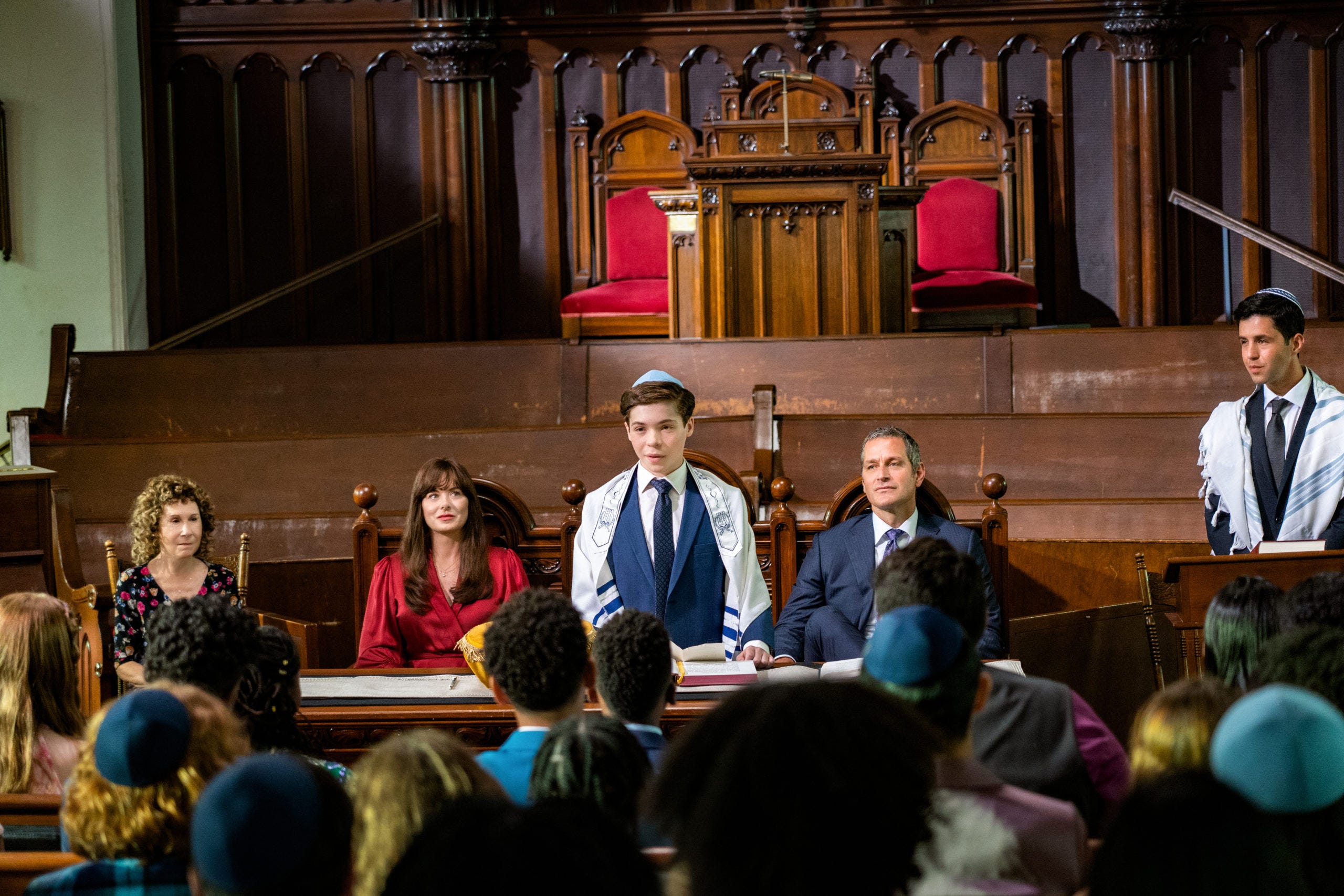
Recently, that connection came full circle with my oldest son. After watching the film version of 13: The Musical—Jason Robert Brown’s musical about a kid navigating a move just before his bar mitzvah—he started asking questions. About being Jewish. About whether he might want a bar mitzvah himself.
We’ve always marked Hanukkah and Passover at home, alongside Christmas and Easter. He’s grown up with a light touch of both traditions. But now there’s curiosity. Maybe it’s the music. Maybe it’s something deeper. Either way, I feel a responsibility to meet it.
So we’re figuring it out together. I’ve also started showing him Seth Rudetsky’s Broadway Shabbat, part of the Jewish Broadway Alliance—a way of connecting his growing love of musical theatre with a sense of Jewish community. It feels like a natural bridge—an invitation to see that there’s a place where those two parts of him can live side by side.
Meanwhile, my younger son has started asking about Jesus, thanks to conversations at school. I’ve wisely turned that job over to my wife. My version would probably end with him singing Andrew Lloyd Webber tunes in class, which feels…off syllabus.
I’ve started building a small library for them—PJ Library books, films, stories that reflect Jewish life and history. The same way my father did for me, just a little more intentionally. As invitation.
And as I do that, I keep thinking about what it means to carry this identity forward. Unlike my younger self, I will no longer do so quietly or apologetically. But I also won’t use my identity as the only lens through which to see the world.
The weight I once felt—passing when it was easier—has lifted. The world my kids are growing up in is more complicated than the one I knew. Antisemitism feels less hidden now, more willing to show itself.
If my son chooses to step into his Jewishness, I want him to do it with clarity. Without hesitation. And knowing that there is a great community of artists and artisans he can find connection with in the life ahead.