

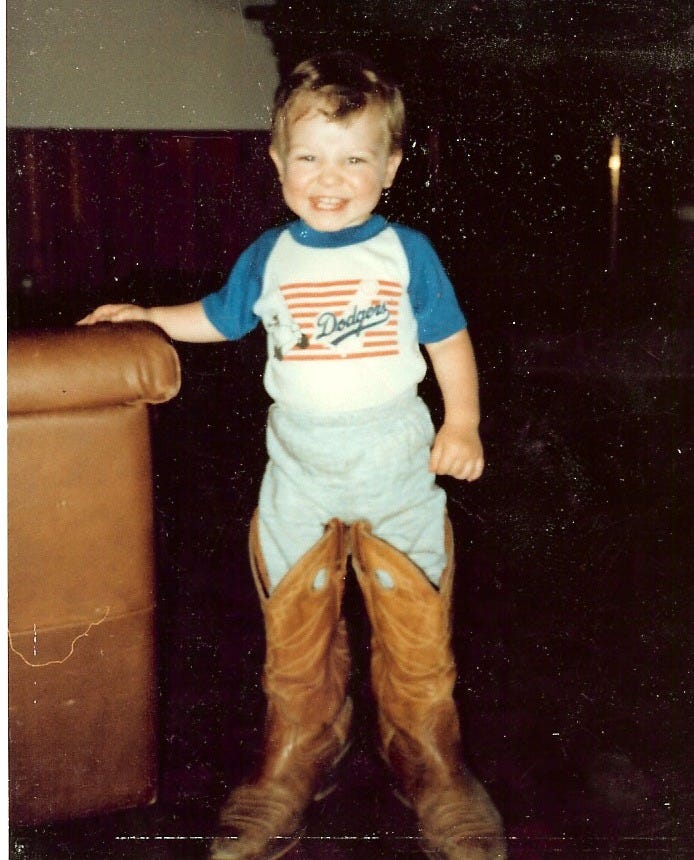
Growing up in Los Angeles, I was clearly destined to be a Dodgers fan, if baseball was going to be my thing.
Of course, sports were most definitely not my thing.
Sure, Little League was played. My parents coached in our city’s league, which meant I clearly ended up playing on their teams. When positions were assigned, I had one desperate plea running through my head: Put me in the outfield.
I did not want the pressure of the infield.
The best I could hope for was an afternoon kicking at the grass while most of the kids failed to hit anything beyond second base. If the ball did come my way, I became remarkably adept at miming blindness from the sun. Please, don’t let it be overcast, I would think on game day. Anything to avoid getting hit in the head by a missed pop fly.
Suffice it to say, I was an artsy kid from an early age. An aptitude for playing sports was never in the cards.
And yet, I appreciated the tradition of the game. The umpires became family friends. Watching from the outfield wasn’t exclusively about picking weeds from the grass. I may not have been cut out to play the game, but I was definitely cut out for watching a show.
And I was an impressionable Angeleno in 1988 when Dodger-mania swept the city.
Tommy Lasorda at the helm. Vin Scully on the airwaves. Orel Hershiser on the mound. The echos of “Fernandomania” still in the air from when I was younger for local legend Fernando Valenzuela. Mike Scioscia behind home plate. A fellow lefty with a monster swing, if not a little controversy, Kirk Gibson.
Then came Gibson limping to the plate in the World Series and hitting a historic home run. The Dodgers won it all. Not a bad way to set the stage for a love of the game.
There was also the lore of the great Sandy Koufax, another fellow lefty and one of the greatest Jewish athletes of all time. Koufax famously refused to pitch Game 1 of the 1965 World Series because it fell on Yom Kippur.
Talk about chutzpah.
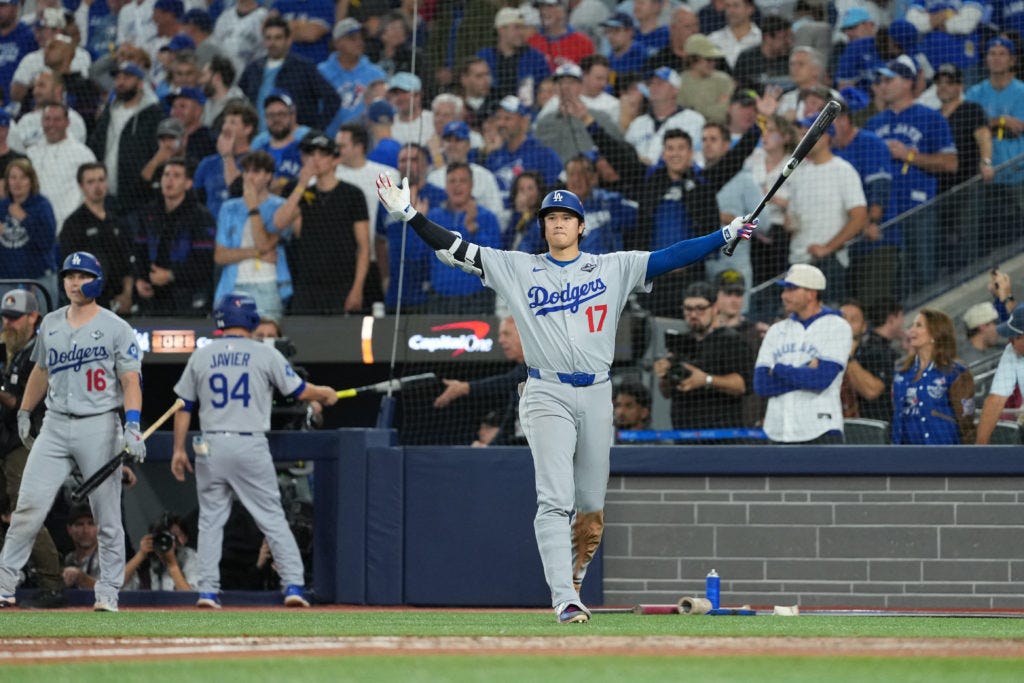
Mind you, Koufax’s time on the field was well before mine, but his legend never faded. Nor did Valenzuela’s. Or Jackie Robinson’s. And now Shohei Ohtani is writing the next historic chapter of Dodgers history.
Setting aside the Dodgers being my hometown team, there was always something about the history of the franchise that appealed to me. Jackie Robinson battle against racism. Fernando becoming a phenomenon who connected the team even more deeply to Los Angeles’ Mexican American community. Koufax choosing his faith over a World Series start.
These were stories that made the Dodgers feel bigger than nine guys playing baseball.
It was especially meaningful to see Koufax join President Barack Obama at the White House in 2010 to celebrate the inaugural Jewish American Heritage Month. Here was a legend of my hometown team representing my fellow American Jews in a poignant moment for the country.
“This is a pretty distinguished group. We’ve got senators and representatives, Supreme Court justices, successful entrepreneurs, rabbinical scholars, Olympic athletes—and Sandy Koufax!” Obama said. “Sandy and I actually have something in common. He can’t pitch on Yom Kippur—and I can’t pitch!” Ditto!
For most of my life, the Dodgers have felt like a love letter to Los Angeles. A team made for a city built on fame and fantasy, creating dreams for the rest of the world.
The World Series wins in 2024 and 2025 felt like dispatches from home as I watched from the opposite side of the country in Connecticut, where I now live. Every flash of Dodger Stadium on television brings another flash of memory. Driving around the stadium on my commute to work. Going to games as a kid. Going back years later as a dad with my own kids.
I’ve even managed to get my 3-year-old daughter to yell “Let’s go Dodgers!” throughout this latest season. It doesn’t hurt that she has somehow developed a crush on Shohei Ohtani. Haven’t we all, kiddo?
But seeing Dodger Stadium also brings back another Los Angeles memory, one I didn’t know anything about when I was the kid sitting in those stands.
There are ghosts under that field.
Before there was a Dodger Stadium, there were three neighborhoods filled with Mexican American families on those grounds. In 1950, the Los Angeles Housing Authority began acquiring the land for a public-housing project called Elysian Park Heights. Those families living there were told they would have the opportunity to return to the new development. With that, some sold their homes while others were kicked out through eminent domain.
The housing project ultimately fell apart amid a political backlash against public housing. By the time the Dodgers struck a deal to build there in 1957, most of the families were already gone. Some of those final residents were evicted in 1959, just months before construction on Dodger Stadium began.
I had no idea about any of this growing up.
I learned it from Chavez Ravine.
Commissioned by Center Theatre Group, Culture Clash’s play took on that complicated history with their signature mix of comedy and satire.
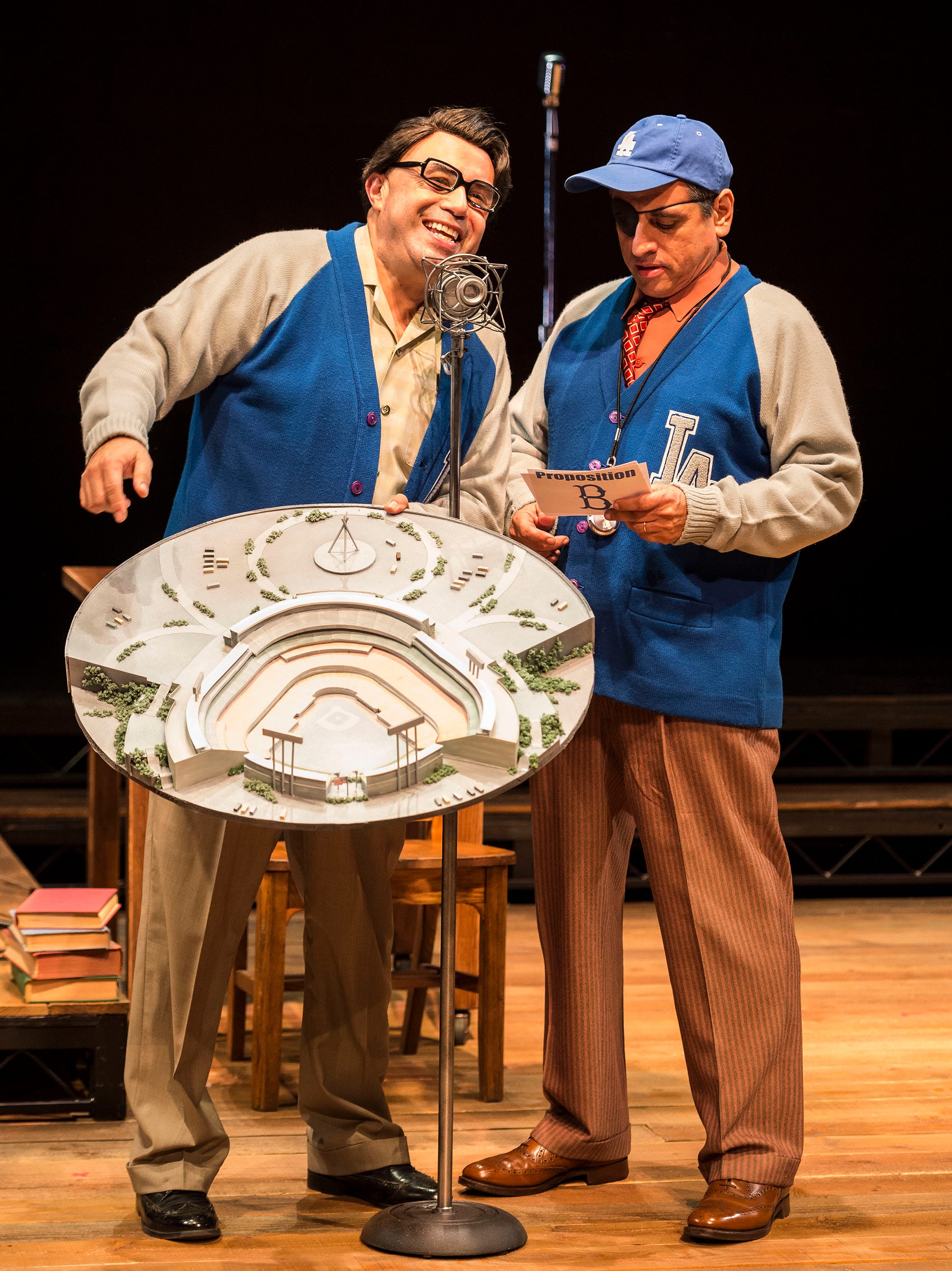
It opens with Fernando Valenzuela on the mound, suddenly seeing the ghosts of the people who had once lived where thousands of fans were now sitting.
I saw the original run at the Mark Taper Forum, and afterward I couldn’t look at Dodger Stadium quite the same way. The place still held all the things I loved about it, but now there was another story attached to it—one I had somehow grown up in Los Angeles without ever knowing.
So, when I later found myself working at Center Theatre Group as Culture Clash returned for a revival of Chavez Ravine in 2015, I selfishly followed every beat of the process. I scoured the theatre’s original archival material while developing marketing materials and found plenty of excuses to watch rehearsals.
Then I got to do it all over again when we revisited the piece digitally during COVID, while our theatres sat empty.
Each time was another bite at the apple of something that combined so much of what I loved about my hometown: Dodgers blue, a twist of noir, political shenanigans, and the glitz of the arts.
It also complicated my love for this place in a way that only made it more interesting.
Los Angeles is very good at pretending it has no past. Tear something down. Build something shinier. Put up a palm tree. Roll camera.
But the past has a funny way of hanging around. So does baseball.
After my bout with Little League, I knew sports weren’t going to be in the cards for my extracurricular life. That didn’t mean I could escape them. High school physical education saw to that.
Whenever baseball came around, I had the same thought I’d had as a little kid: Would I at least get assigned to the outfield?
There was one new problem. These guys could actually hit the ball that far.
Worse, I was a lefty, and there never seemed to be a left-handed glove anywhere to be found. I lost track of the number of times I had to catch—or, more accurately, not quite catch—the ball, rip the glove off my hand, grab the ball with the same hand, and then throw it. It was not graceful.
Baseball became a sport of personal shame for me. Loving the game wasn’t easy when my own aptitude for playing it was so dismal. It felt intimidating even to say I liked baseball after years of feeling embarrassed on the field.
And I really didn’t care about other sports beyond a passing appreciation. By high school, having grown resentful of the intimidating jocks around me, I tucked my love of baseball away with the rest of childhood.
Then, years later, I turned to Vin.
I had started dipping back into my love of the Dodgers when I got the chance to work some games through the radio station broadcasting them. When my regular on-air shift collided with a Dodgers game, I worked the board, listening closely so I could hit the local commercials.
Often, I was the only person in the building. I would sit quietly at the board and close my eyes to listen to Vin Scully.
As a broadcaster myself, I found myself studying him. The cadence. The art of narration. The confidence to let a moment breathe. I couldn’t imagine anyone else calling a Dodgers game. When someone else was on the mic, my interest waned. Vin brought my childhood love of baseball back to life. I’m not sure it would have reemerged without him.
He was the voice of the Dodgers. The voice of Los Angeles. And, for me, the voice of that kid who had once loved baseball before somebody made him think he needed to be able to play it.
Sitting alone at that radio board, I felt confident about the game again. I could love baseball without being able to catch a fly ball. Who knew? I tuned out the schoolyard bullies and tuned into Vin.
Now we find ourselves in October again.
For the past two years, my homesickness for Los Angeles has been interrupted by the peculiar joy of watching the Dodgers bring home back-to-back World Series championships. And now, in 2026, they are trying to do it again.
This marks my fifth year away from L.A. after moving to Connecticut. Each year removed makes me a little more homesick. With less and less family still living there, the Dodgers have become one of the last reliable portals into my childhood.
Maybe that explains why I’ve latched onto the boys in blue that much harder these past few years.
There is a strange thing that happens when you leave the place where you grew up. Ordinary things transport me back. The 405. Canter’s Deli. Magic hour through the haze of smoggy downtown. And a baseball team decked out in blue.
I’ll always love L.A. The real L.A., with all its contradictions. The picture perfect ballpark and the ghosts underneath it. Koufax refusing to pitch. Fernando staring in from the mound. Ohtani stepping into the batter’s box. A little kid praying nobody hits a ball to left field.
And now another little kid, 3,000 miles away, yelling “Let’s go Dodgers!” because her dad taught her the chant. Maybe that’s what baseball was always supposed to be for me. Not something I had to play. Something I could carry with me.
And now, as Vin Scully would tell us at the start of every game: “It’s time for Dodger baseball.”
You’re the best Angeleno, even from afar.