

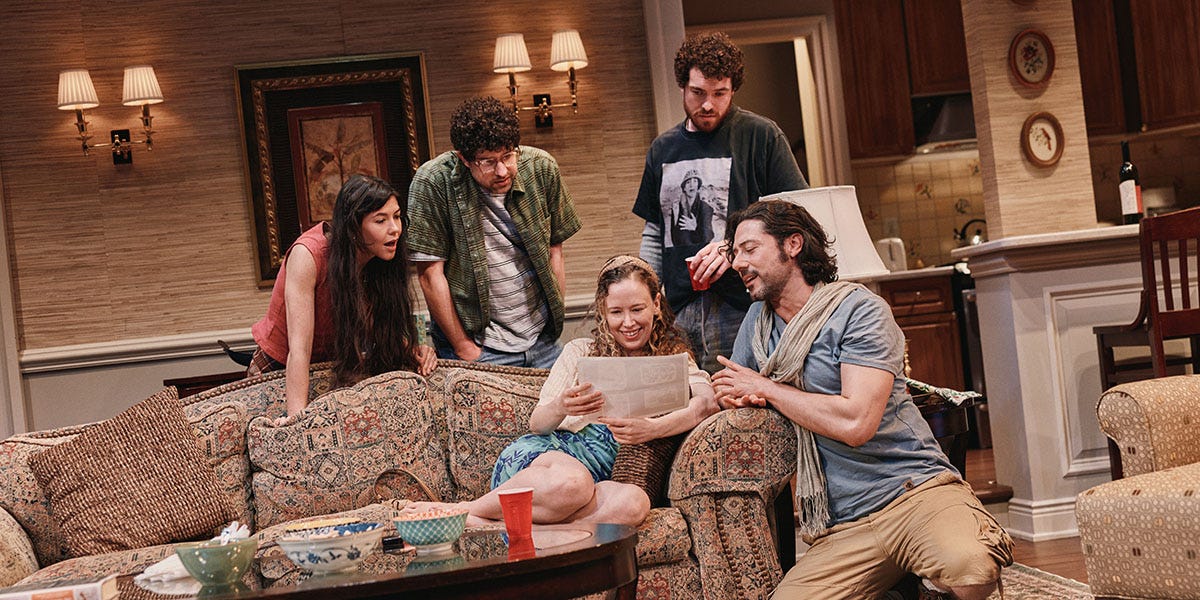
Theater Workers for a Ceasefire has called for a boycott of Birthright by playwright Jonathan Spector at MCC Theater for the “normalization” of art that includes criticism of Palestinian violence toward Israelis on October 7. The group particularly objects to a scene in which two characters debate the attacks and who should be seen as the victim.
Calling for the boycott or cancellation of artists merely for presenting ideas rejects the harder task of engaging in informed conversation. Silencing is too simple. The greatest power of an artist is to create art, and a boycott is not art.
Cheering for attempts to silence art has the risk of unintended empowerment. Recall the neo-Nazi protest outside the first performance of the 2023 revival of Jason Robert Brown’s Parade at New York City Center—a musical that told of the lynching of Leo Frank, a Jewish man falsely accused of murder in Georgia. The show’s producers responded: “If there is any remaining doubt out there about the urgency of telling this story in this moment in history, the vileness on display last night should put it to rest.”
Last month, actress Natalie Portman and other filmmakers rebuked a petition from other Hollywood heavy hitters calling for a cultural boycott of Israeli film institutions deemed “complicit in war crimes.” Their response asked: “At what point does public funding make a work, or even its creator, seem like a spokesperson for that state, even when the artist is sharply critical of it?… Nothing justifies silencing an artist’s voice.” They ended their letter pointedly: “Cultural boycott is an intellectual dead end that we must collectively move beyond.”
Please, artists: perform, don’t be performative.
A video of theatre director Susan Stroman recently showed up in my feed in which she recalled a moment that a patron in the front row of The Producers on Broadway once became incensed when actor Gary Beach appeared onstage dressed as The Führer in the number “Springtime for Hitler.” The audience member ranted down the aisle, confronted creator Mel Brooks in the aisle, verbally sparring with him before the two were dragged into the street.
I find much of what is coming out of the White House abhorrent—often downright authoritarian—yet I do not call for a boycott of everyone doing business with America. I express my views through writing and voting and working for organizations that seek the betterment of society.
Were Birthright being produced by Benjamin Netanyahu or his Israeli government, with its profits directly funding their actions, a boycott of that business pipeline might have a rational edge, whether I agree with it or not. Here, the call is to punish the audacity of presenting opinions on a stage.
When boycotts circle around an ideology or an entire people, it is not difficult to find links to something darker. Boycotts against Jews have a long history. Germany attempted to stop patronage of Jewish businesses in 1933, marking an early step toward the darkest of Nazi atrocities.
What we see playing out now is a scene featuring artists fighting artists, trying to cancel one another over claims of antisemitism or the lack of sympathy for Palestinian rights, often conflating the two. It’s the conflation that is dangerous.
Birthright dares to articulate conversations happening around the world about the tension between what it means to be Jewish and Israeli politics. Is that really what is driving artists to boycott an already sold-out show?
Boycott a conversation?
The brutality of the attacks perpetrated upon Israelis on October 7 must be able to hold space alongside the brutality of Netanyahu’s actions against Palestinian civilians. Two ideas can be debated at the same time. Boycotting art for attempting to explore that divide is boycotting the idea of dialogue across difference.
The silencing of Jewish ideas onstage is nothing new.
In 1883, the Russian government banned Yiddish theatre, basically killing the movement for nearly two decades.
Playwright Arthur Miller failed to get his first play, The Grass Still Grows, produced by the Group Theatre in 1938 because, as he wrote, “they decided they didn’t want to do another Jewish play this year.” Miller found it inconceivable that a producer might refuse a play because “in these times it was better not to show Jews on the stage, especially when some of them are not always laudable in motive.”
Theatre has long provoked religious sensitivities across faith traditions. The origins of Center Theatre Group—my former employer—are rooted in the tale of its inaugural production at the Mark Taper Forum, The Devils. Catholic church leaders in Los Angeles deemed the play blasphemous and mounted a pressure campaign to shut it down. Then-Governor Ronald Reagan famously stormed out in disgust after the first act. And yet, the production persisted. Offense was had while the art marched on. Thank God!
While working at Center Theatre Group, we helped bring Paula Vogel’s Indecent to the stage. The play told the story of the controversy surrounding Sholem Asch’s God of Vengeance, which depicted a Jewish brothel owner discovering that his daughter had fallen in love with one of the prostitutes working there. When the play arrived on Broadway in 1923, its producer and cast were charged with immorality.
The idea that Jewish stories—controversial or otherwise—can again be attacked for spreading challenging perspectives should feel unimaginable in 2026. Yet the deep roots of antisemitism, compounded by the immoral political actions of a country’s government, have made this moment feel almost inevitable.
And for that, we should all feel shame.
Shame that both Jewish and Palestinian voices are constantly subjected to attempts at silencing their perspectives.
Theatre must remain a place for difficult conversations, where audiences can question what they believe and sit with uncomfortable emotions. Choosing not to attend is always an option. So is criticizing the work. Neither requires silencing the artist for asking questions.
That is the true meaning of artistic freedom.
A work may feel abhorrent or heretical, as some claimed of the recent Off-Broadway satire Slam Frank, which reimagined Anne Frank as a pansexual Latina named Anita Franco. I certainly clutched my pearls at the description, but some members of the Jewish community called for its “immediate cancellation.”
Somebody page Mel Brooks!