

Before your kids make their way to college—or not—where one can only hope they’ll stumble into the orbit of a film professor, or maybe an entire program, that feeds their soul with the history of Hollywood, you can get started much earlier. Streaming has made that easier than ever. A child can now be introduced to old movie magic from the couch, one carefully chosen title at a time.
Humble brag: I had that kind of education at home.
I was raised in a working Hollywood family, which meant the craft and mythology of moviemaking were present from my earliest memories. My father gave me a childhood film education that would rival plenty of college survey courses. He told behind-the-scenes stories about filming on the notorious debacle that was Heaven’s Gate, shooting late at night on the side of a highway for Planes, Trains and Automobiles, and working on MGM’s backlot in its waning days. Those stories, paired with his own love of classic movies, made the old studio era feel not distant, but alive. I didn’t just watch those films. I inherited them.
And yes, there is a fine line between having the taste of an old soul and being a movie snob. I cross it regularly.
So when I had children, I had every intention of raising them on the good stuff. Not just “good” in the broadest sense, but good in the tactile, handmade, deeply felt sense. Films with matte paintings and practical effects. Movies where costumes looked lived in because they were. Animation that came from human hands rather than a rendering farm. CGI Mickey? No thanks. The original Mickey Mouse Club? Now we’re talking.
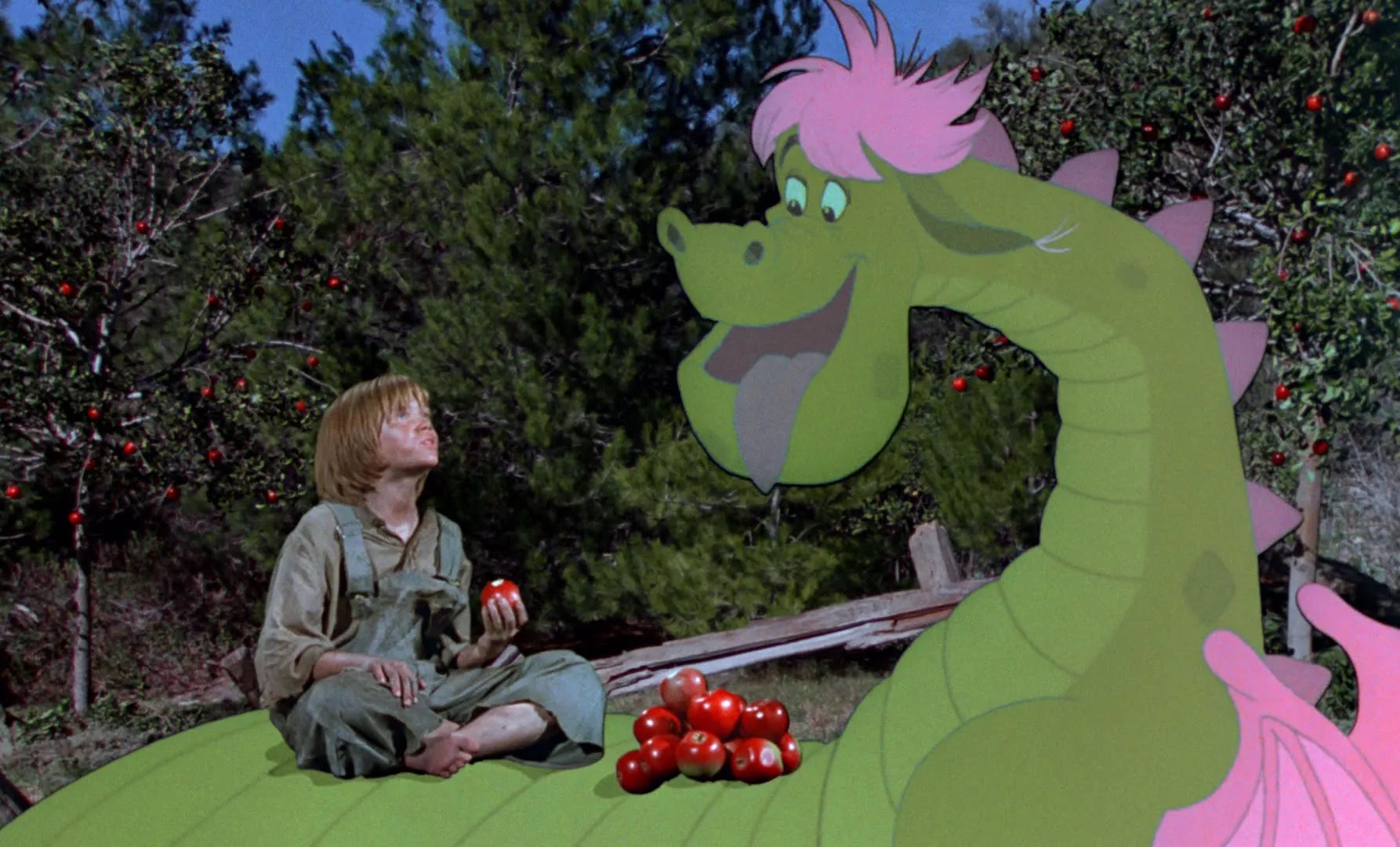
Of all the Hollywood magic that got under my skin, the movie musical may have had the deepest hold. I watched and rewatched everything from An American in Paris to Yankee Doodle Dandy. And then there were the Disney live-action films and musicals that fused old-Hollywood polish with a kind of family-friendly weirdness that still feels unmatched. Helen Reddy dancing on beer barrels oppose a sloppy Mickey Rooney in Pete’s Dragon. David Tomlinson selling his slipshod magic to Angela Lansbury while hurtling through the sky in Bedknobs and Broomsticks. Annette Funicello batting away Ray Bolger in Babes in Toyland. Even the opening songs from Davy Crockett and Zorro permanently reset the standard in my head for what a theme should do.
It was those classic Disney films, maybe even more than the cartoons, that sealed my lifelong affection for the Mouse House: The Apple Dumpling Gang, Pete’s Dragon, 20,000 Leagues Under the Sea, Pollyanna, Swiss Family Robinson, Old Yeller, The Parent Trap, The Shaggy Dog. They all carried a certain texture. A warmth. A sense of place.
And in many of them, that place was tied to my own backyard.
Disney’s Golden Oak Ranch in Santa Clarita sits on the northern edge of Los Angeles County, in the town where I was born and raised and where my two boys were also born. My dad worked there on projects including Something Wicked This Way Comes. So every time I see those oak trees, that covered bridge, that old-town backlot, I’m not just seeing a movie location. I’m seeing a piece of home. A physical landscape that shaped the emotional landscape of my childhood.
Which is why, as I’ve started curating the films I’ll slowly introduce to my kids, I keep returning to those live-action Disney titles. They are my preferred gateway drug. I still haven’t had the heart to show them Old Yeller—I am not emotionally prepared to relive that one, much less manage the resulting childhood trauma—but I have spent this weekend successfully convincing my 2-and-a-half-year-old daughter that she loves Pete’s Dragon. I keep telling her that her brothers and I grew up right near Passamaquoddy. Is that a slight parental embellishment? Perhaps. Is it working? Absolutely.
As she gets older, I want to pass down the stories my father passed to me, and with them a love not just of movies but of how movies are made. Not who has the fastest processor. Not who can type the slickest AI prompt. The people who make practical magic. The propmakers, set dressers, makeup artists, scenic painters, puppeteers, matte artists, costume teams, and location crews. The artisans whose work gave movies weight and atmosphere and credibility. Even the most fantastical alien world once felt real because, in some meaningful sense, it was.
That matters to me all the more now because the culture is in danger of forgetting how much that handmade quality contributes to the emotional force of a film. Part of the reason audiences responded so strongly to Project Hail Mary this summer, as a recent Hollywood Reporter story emphasized, was its refusal to lean on a wall of digital emptiness. Director Christopher Miller said, “Not a single green or bluescreen was used,” and described building the ship as a real set while using practical backgrounds and an animatronic Rocky on set. That is exactly the kind of thing kids should be taught to notice: why something feels real, not just whether it looks expensive.
And there’s a bigger stakes question underneath all of this. Hollywood’s physical craft base and workforce need protecting, not nostalgic handwringing after the damage is done. As the Los Angeles Times reported, Sen. Adam Schiff argued that “the urgency could not be greater” when it comes to competitive incentives to keep production in the United States. He rightly framed the issue not around celebrities, but around the crews whose labor creates the illusion in the first place. Keep Hollywood in Hollywood. Get the tax structure in place before the industry offshores what remains of the real thing.
Because what I want my kids to appreciate is not just movie stardom but movie labor. I want them to understand why Vasquez Rocks matters. Why a backlot matters. Why a practical creature matters. Why a location carries memory in a way a green void never can. Captain Kirk fighting the Gorn meant something more when you knew that landscape actually existed just down the road.
If we still lived in Southern California, I’d probably nudge them toward the old Main Street magic-shop fantasy—learning sleight of hand for Disneyland guests, Steve Martin-style—instead of dreaming about coding the next digital universe. Though given the state of the business, I might also need to add a wing to the house where they could live forever while pursuing that noble artisanal path.
One thing is certain: I plan to send them into adulthood with Turner Classic Movies, shelves stocked with Leonard Maltin, Neal Gabler, and Sam Wasson, and enough exposure to old Disney that they’ll instinctively recoil when a beloved character starts looking too algorithmically polished. In our childhood home, we had a bust of Yul Brynner’s head that had once been used to prepare makeup for Westworld. Imagine growing up with that in the living room. It had gravitas. It had mystery. It was both décor and doctrine.
I don’t have Yul here with me in Connecticut, but I do have access to old Hollywood and a determination to pass it on. I also still have those glorious tins of Disney Treasures DVDs, the kind of lovingly curated physical-media object that now feels like an artifact from a more civilized age. Film historian and true mensch Leonard Maltin recalled pitching what became Walt Disney Treasures as a more organized way to reach “collectors, Disney buffs, and families and kids,” and later lamented that Disney never really gave that material “another lease in life” online. He was right. Those sets understood that curation is part of education.
And that, really, is the point.
You don’t have to wait until your child can appreciate film noir, decode aspect ratios, or understand why black-and-white photography can feel more emotionally lush than many films shot last year. The golden age of Disney live-action movies is sitting there waiting, full of craft, music, invention, humor, and heart. It’s a ready-made film school from the comfort of your couch.
And if your kid resists at first, do what I did: fib a little. Tell them how much they loved it last time. Hype it up. Try again. At some point, it will go down like a spoonful of sugar.
And if they still choose Barney over Pete’s Dragon, then I regret to inform you the situation may be dire. At that point, it may be time to revert to no-screen parenting, because there are some roads from which a family simply does not return.
"I want them to understand why Vasquez Rocks matters." (I clapped at this, alone in my office :) )